
Could Halifax homeless charity's trailblazing work help Andy Burnham end rough sleeping?
If Andy Burnham wants to end homelessness, he could do with looking at the groundbreaking work a Halifax charity is doing.
Happy Days has a pioneering approach to supporting people who are homeless and at risk of being homeless across Calderdale.
And CEO Ellen Boothe says she is more than happy to show the new prime minister – who pledged to end rough sleeping during his first speech in Downing Street – how they are implementing it.
"When you talk about ending homelessness, it’s not just about providing everyone with a roof,” said Ellen.

"It’s much, much more complex than that.
“Homelessness is often the result of a combination of factors, including adverse childhood experiences, trauma, poor mental health, addiction, relationship breakdowns, poverty and a lack of stable support networks.
"Providing a safe home is absolutely fundamental, but for people to truly move away from homelessness, they also need the right support around them to address the things that have contributed to them becoming homeless in the first place.”
Much of what the charity has done - and plans to do - come from the findings of the harrowing Burnt Bridges report, which detailed the deaths of five homeless men in Calderdale in just four months during the winter of 2018-19.
Its findings and recommendations sparked huge changes in the way agencies across the borough tackle rough sleeping.
"Things had to change,” said Ellen.
"In 2022, I became CEO and worked very closely with Public Health to say ‘what is it that we need to do differently?’
"We opened our winter 24/7, removing the need for people to leave in the morning and return again at night. This meant we could provide wraparound support throughout the day, which was incredibly important.
"Our complex lives coordinators work with each individual to look at mental heath, physical health, offending background, substance use, housing history, social networks and financial wellbeing.”
She said the Burnt Bridges report demonstrated that simple solutions would not suffice for those with multi-complex needs and multiple disadvantages, like the men who died.
“While support had previously been available from a range of different agencies, the chaotic circumstances of the people who needed that support often created significant barriers to accessing it,” Ellen explained.
Instead of homeless people needing to find ways to get to and keep appointments, Happy Days now brings specialist services to those they need to speak to, all under one roof at the charity’s base on James Street, where homeless people feel comfortable, safe and welcomed.
These include Calderdale Recovery Steps, Bevan Healthcare, Healthy Minds, the NHS Wound Clinic and Calderdale Council’s housing team.
"What partner organisations found was that all the individuals they were struggling to engage with, who continuously missed appointments, could often be found at Happy Days,” said Ellen.
"What we’ve realised is that relational, trauma-informed approaches and a non- judgemental environment are really important.
"We are creating a walk-in complex lives hub with a zero-appointment approach. It’s more difficult to run but this is what works, ensuring those we support have access to services as and when they need it.
“Public services are stretched, but when you have projects like this, you are taking pressure off those services, freeing up public resources to be used in the way they were intended.”
Happy Days has big ambitions for the future, including being able to refurbish its building on James Street so that its shelter – which currently only opens during the coldest six months of the year – can open all year round, offer more rooms and increase capacity.
Ellen said while they have seen many people who have stayed at the hostel go onto live in supported and independent housing, there have also been tragic outcomes for some who were not ready to leave when the hostel closes each year in March.
"Just because it becomes slightly warmer, it doesn’t stop the crisis,” said Ellen.
"It’s not as simple as somebody coming into a shelter for a few nights and then moving them on to accommodation, because that doesn’t work.
"It just leads to repeated cycles of homelessness.
"We need a multi-agency response, but we also need that response to be flexible and trauma informed.
"People’s needs are complex and they don’t all fit into a set pathway or a fixed timescale.
"We have to be able to work with people where they are, build relationships and provide the right support at the right time.
“Whilst there’s been some changes since Burnt Bridges, there’s a lot more to do.
"What I hope Andy Burnham’s plan brings is an understanding around what truly needs to happen if we are serious about ending homelessness.
“It’s about providing the right accommodation and the right support, with a flexible, trauma-informed approach and there simply isn’t enough of that out there.”
The charity provides intensively supported safe, dignified housing for seven individuals who are well known to local services but whose needs have not been met by any existing provision in Calderdale.
This service exists to support people who have repeatedly fallen through the gaps of traditional systems, ensuring they receive the accommodation, stability and support they deserve.
"Both this project and the winter shelter operate under a high tolerance, harm reduction model.
"This means we do not evict people for the very reason they’re there in the first place,” Ellen explained.
"So we will not evict someone for having an addiction or alcohol dependency. That is the opposite to most projects, even shelters.
"Going back to Burnt Bridges, people were evicted to the street for the problems that they had due to trauma that they had in childhood.
"Reversing that model and saying ‘we will help you to reduce harm as you are now’ was a complete change in dynamic.
"Suddenly people told us everything so we were able to give them the most appropriate support, and quite often that’s lifesaving.”
Happy Days also has 61 flats across 2 sites, 51 of which are supported accommodation and 10 of which provide affordable accommodation in a community setting.
All the charity’s supported accommodation residents work with complex lives coordinators and housing officers to build a bespoke housing and support plan.
They work collaboratively and at a pace that is right for each individual to prevent homelessness and create pathways towards long-term housing stability and independence.
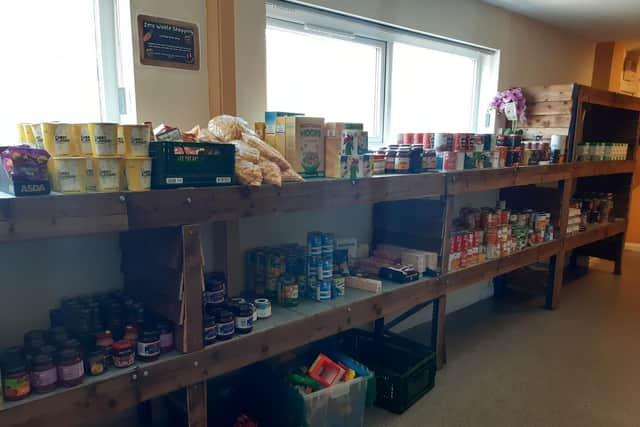
Happy Days also runs a community supermarket in what used to be the Salvation Army building on St James Road.
Member-based, it replaced the food bank to offer people more control, choice, dignity and financial inclusion.
For a £6 charge, users can visit the supermarket once a week and choose up to 15 items as well as the chance to open a credit union account.
And it has a community cafe, providing hot meals on Monday, Thursdays, and Fridays between 12.30pm and 1.30pm, and breakfast every weekday from 9.30am until 11am.
For Happy Days, the ambition is not simply to only respond to homelessness when someone reaches crisis point, but to put people before systems — recognising the complexity of their lives and the impact of previous trauma, removing barriers to support, and giving people the opportunities they need to move forward.
For more details visit https://happydaysuk.org/