
History Society column: Votes for women - campaigns across Calderdale
It is almost a hundred years since women won political equality with men.
In 2028 we shall be celebrating the successful end of the long campaign for votes for women. Jill Liddington, who has spent her career as an academic researching and writing about women’s history, has uncovered the stories of activist women of Calderdale and beyond, which she presented to Hebden Bridge Local History Society.
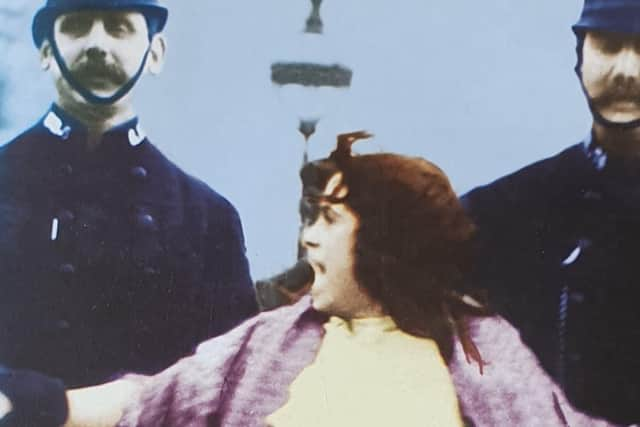

Jill reminded us of the distinction between Suffragists, who campaigned actively but avoided breaking the law and Suffragettes who used direct action and were often imprisoned for their protests. The latter movement – the Women’s Social and Political Union (WSPU) – is the one whose activities have the strongest presence in popular history.
Jill’s researches have uncovered a disparate movement often with strong working class roots where women could find support. Lavena Saltonstall, working as a tailoress in Hebden Bridge at the age of ten, became an enthusiastic member of the WSPU, a suffragette who was sent to prison twice, including for six weeks in 1908. During this time of course she would have had no wages and no access to any support and decided that militancy was too risky. But she found a new channel for her ideas, through her membership of the Workers Educational Association which gave her the opportunity to express her views in their magazine The Highway and to write an autobiography Letters from a Tailoress.
Mary Taylor also came from a working class family in Halifax. She married Arthur Taylor, a blacksmith, a Trades Unionist and rising star of the Independent Labour Party. ILP women issued a manifesto supporting the WSPU in 1907, signed by 26 Halifax women with Mary Taylor one of the most prominent. She too spent time in prison but clearly felt supported by her husband. She took part in the boycott in protest against the census in 1911, as her name is missing from the census return completed by her husband.
It was not always the case that working class movements supported the suffragettes – especially after the WSPU turned to more violent tactics. The powerful Todmorden Weavers Union, despite women making up the majority of the membership, had no women on the committee and rare mentions in the minutes. There is no evidence of the Women’s Co-operative Guild in Todmorden supporting the suffragettes. Minutes reveal that ‘no action was taken’ when the women discussed a protest parade in Manchester, and ‘no discussion could be got’ when renowned suffragist speaker Selina Cooper came to address them. However, Margaret Bonfield, of the Shop Assistants’ Trade Union, was warmly welcomed, arguing for the wider cause of adult suffrage as proposed by the People’s Suffrage Federation.
Local and Family History research uncovers such details, and names beyond the famous suffragettes.
Mary and Arthur Taylor remained a politically committed couple, he an Alderman and she a Poor Law Guardian, JP and Magistrate. Their names will be commemorated when a blue plaque is affixed to their home in Skircoat Green next year.
A drawing of the house made by Mary when she was in Holloway is still treasured by the family.