
"It was an unmitigated disaster" - The inside story of Town's last season in the Football League 25 years ago
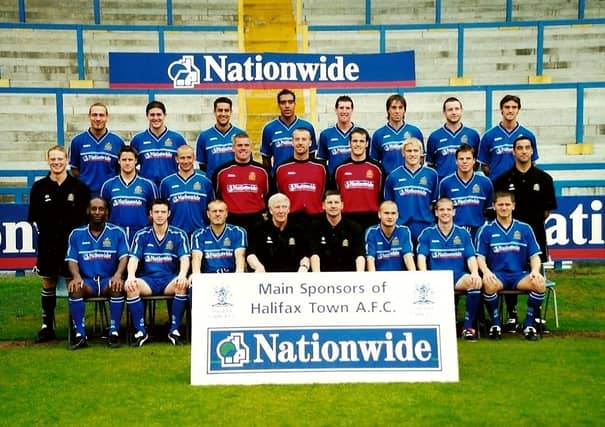

It's 25 years since Halifax Town were last in the Football League.
Town were relegated in the 2001-02 season, finishing rock bottom of what is now League Two having won just eight games, finishing on 36 points, 11 adrift of safety.
Our Shaymen reporter Tom Scargill spoke to former Halifax players and a club director from that time for the inside story of that season.
Just four years after Town's gloxrious, sun-soaked promotion under George Mulhall, The Shaymen were relegated under dark, forbidding clouds.
In fact, the warm glow of promotion in 1998 faded all too quickly.
After a tenth-placed finish in their first campaign back in the Football League, the only way was down. It was then 18th, 23rd - surviving by just two points - and then 24th.
Relegation was the result of a perfect storm: poor recruitment, a squad lacking in quality and confidence, managerial changes and off-the-pitch troubles.
And from pre-season in summer 2001, the writing seemed to be on the wall.
"Brace came in during the previous Autumn, the consortium backed him and he brought in quite a few players on decent money, more money than us who'd been there were on," says goalkeeper Lee Butler.
"But then it backfired."
Butler says Bracewell was a disciplinarian and the Town squad didn't really take to his methods.
"He tried revolution, not evolution," Butler says.
"Training with Brace and Richie Barker (assistant manager) was full-sided games and shape every day, you didn't really enjoy coming into training.
"You do have to do that, I understand that having been a coach for 20 years, you've got to be organised, but every day you'd pull into the pitch at Elland and see it set-up for a practice game and your heart would sink!
"So the atmosphere was a bit low, no-one looked forward to coming to training because we knew what we were going to get.
"We probably had a bit more optimism than just staying up, like the season before, I think we thought we wouldn't be struggling, we'd maybe be halfway up.
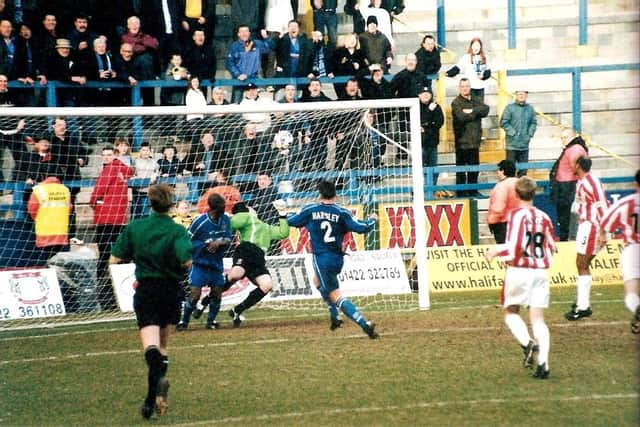
"But training didn't inspire you to come in and work.
"There was certainly optimism that we'd finish higher than second-from-bottom, but obviously that was misplaced."
Doug Tait was a board member at Town at the time, and says the playing budget was increased under Bracewell.
"His philosophy was fewer players but who were more intelligent in terms of football, who he thought he could coach to a decent standard," he says.
"I remember the game at Easter the season before, one of the Clarke twins got concussion and Bracewell didn't take him off at half-time, he carried on playing.
"All the lads were protesting about it and he lost the changing room.
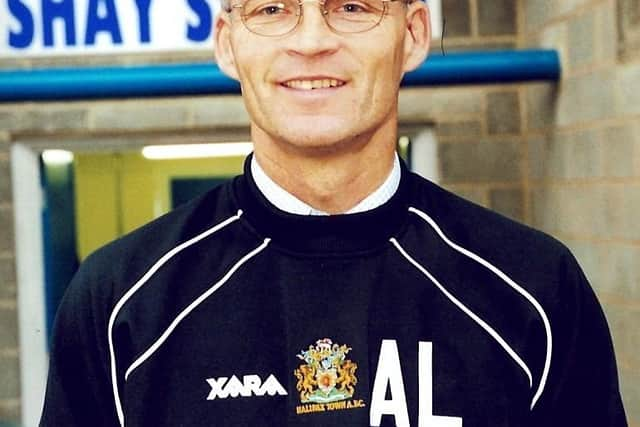
"He had Graham Mitchell on the bench but him and Graham didn't get on, so he didn't bring him on."
Both Butler and Tait say Barker's robust approach caused issues too.
"We weren't happy about him having an older man, who'd been his first manager, as his assistant," says Tait.
"Everyone said it was a great move because of his reputation, but by the end of it, no-one had any time for him.
"So he parted company with us because we said 'he needs to go', but Bracewell said 'well if he goes, I go'."
Town's opening day win at Lincoln was one of only three away league victories all season; talk about a false dawn.
Bracewell left after a 2-0 home defeat to Oxford, five games into the campaign.
Defender Andy Woodward says he got a sense that things didn't seem right.
"He dropped a right b*****k on me!," he said
"I was going to go to Scunthorpe but Bracewell sold (Halifax) like a dream, what the club was doing and the goals, he was going on about how he wanted to build a great team and was looking to the future.
"So when he went it was a major shock and I was like 'what have I done?'.
"We were on the floor and Neil Redfearn stepped up but it was a nightmare for me.
"I'd had panic attacks and a panic disorder, I'd been at Sheffield United but I wasn't good in my own mental heath, and it was a massive blow to me."
Chairman Bob Walker claimed Bracewell's resignation was a "short, sharp shock", and having failed to persuade him to change his mind, turned to Neil Redfearn and Tony Parks to look after the first team.
"Redders was great for me," says midfielder Paul Harsley, "because I'd primarily been a midfield player up to that point.
"Bracewell signed me and I was playing as a right-back, which was fine, but Redders put me in midfield and gave me a bit more encouragement to go forward, a bit of freedom, so I really enjoyed the time with Redders in charge, and Parksy as well because he was larger than life.
"It did bring a different feel to it and we all felt a bit of a lift in that period."
After a last-gasp defeat at York, Halifax won two and drew two of their next four, and moved up to tenth in the table.
Both Redfearn and Parks seemed keen to make the positions permanent but after protracted negotiations - the stumbling block appeared to be the length of contract on offer - the talks ultimately broke down.
Town won only one league game between September 22 and January 12; talk about a bleak mid-winter.
"There was a good feeling about it," says Harsley, Town's top scorer that season with 11 goals. "I think everyone would have been happy to see them get the job.
"Everyone seemed to be in a good place but the club decided to go in a different direction, which is fine and you get used to it.
"It was a good period that and there was a good team spirit."
Defender Mark Jules believes The Shaymen might have stayed up had Redfearn and Parks stayed on.
"I think we'd have had half a chance," he says. "Everybody liked them.
"If you're enjoying it, you're going to get more out of the players, they'll run through a brick wall for you.
"I was disappointed they didn't get the role, but you don't know what's going on behind-the-scenes."
Woodward agrees that things would have been different that season had the duo stayed in place.
"Definitely. You can't change what happened but without a doubt, it did lift and Redders was brilliant," he says.
"It would have been different, but the whole dynamic shifted again."
Woodward says Alan Little, who was appointed in October, was "old-school" and that there was "a completely different energy" about the club under him.
"When you're struggling, that energy goes around the changing room," he says.
"You don't get the rub of the green or something occurs in a game, the confidence levels can ripple right through the team, and that starts from the very top.
"You had the management changes, then the lads in the changing room. When you're on that slippery slope, it's hard to get back on the road."
"He was alright," Butler says of Little. "I thought he'd be more of a disciplinarian than he was.
"He was quite modern in his outlook. I'd played against him towards the back end of his career and he was hard as coffin nails, a tough-tackling midfielder.
"He was taking over a sinking ship really."
"Maybe there was a sense of disappointment," says Jules, "because everybody loved Redders and Tony, so he was coming into a changing room where they'd hoped they got the job.
"So he's got the lift the changing room, and it's an uphill task for him from the start."
Striker Steve Kerrigan says the writing was already on the wall by the time Little came in.
Kerrigan's dramatic loss of form hadn't helped either. He'd scored 20 goals the season before, but things were different now.
"I was having a really hard time with my right hip," he says.
"I'd just signed a new contract but I really struggled. Full-time football was really hard for me that season and it got to a point where I didn't train that much, I just tried to concentrate on playing games, but it was really difficult and I ended up getting my hip replaced when I was 40.
"I was told at the time that I had to stop playing football but I'd just signed a new contract, so I kept playing but I was definitely a yard off it."
Halifax won only once in 20 games stretching from December 1 to March 9.
"It was difficult," says Kerrigan. "I missed a good chunk of the season but I did play a good chunk.
"You felt as though, even if we went one up or two up, the confidence was so low that a team was always in the game, you never really felt you were comfortable in any of the games.
"Obviously the club went into administration straight after the season too, it was just a spiral. It was really tough, tough for the supporters obviously but also for the players.
"We were all working class boys so we didn't have the kind of money that meant we were secure financially.
"It was a really difficult time and I felt responsible.
"I took responsibility because I'd obviously been top goalscorer the season before and my goals dried up and the club got relegated, and I took it personally."
"There was quite a lot of changes in personnel, the team was changing a lot," says Harsley.
"Some people are disgruntled, not playing. Without sounding selfish, I could concentrate on playing and just getting my head down, knowing I was probably going to be in the team because I was scoring a few goals.
"But it's really tough, because it's not just on the pitch, it's off the pitch. There were some great lads there, it wasn't anything to do with the lads not being good lads, but naturally people's emotions turn towards money troubles how it'll affect your life."
"Football's all about confidence," says Jules, "so when you're not winning, how do you grow that confidence?
"Sometimes you get that bounce when a new manager comes in but that didn't work either.
"Even when you do get a win or a draw, you have another loss and it drops you back down again and you can't get out of that rut."
Tait had come onto the board in February 2000, when work was about to start on the new East stand at The Shay, as well as roofs on North and South stands.
"We were building it to Super League standard because of the rugby club," he says, "in terms of the number of seats and the lights and everything."
Tait says there were financial troubles with the project which meant it was never fully completed.
"There were issues with the rugby club over the development of The Shay. And their money from the sale of Thrum Hall only being 15 per cent of what it was going to be!
"It was a farce. The council eventually took it on.
"They asked me how much it would cost to finish it and I said half a million, maybe three quarters of a million.
"And they spent £4.5m, they changed it totally. Turning the first two floors upside down from the original plans.
"The corner bit that's never been finished, that's where all the bars and the hospitality was going to be, on three floors, a bar, a restaurant, a VIP room.
"They swapped things round, smashed things up and re-did them, spending all this money, taxpayers' money."
The unfinished corner between the main stand and the South Stand was left as structural symbolism to a shambolic season.
"On the field issues didn't help," says Tait. "ITV Digital went bump and our income from them was about £200,000.
"The Clarke twins (Chris and Matthew), Kevin Keegan wanted to sign the centre-half but he was going to take them both because they'd always been at the same club together.
"He was going to pay us half a million for them, but when ITV went bump, they lost millions and there were next to no transfers that summer.
"Then we played Stoke City in the second round of the FA Cup, and Rob Herbert - who shared a room at my house with my son Andrew, who was in the youth team - he was through on goal with just the keeper to beat and he put it wide.
"And he joked to me afterwards 'well, we'll go to their place and beat them there'."
Town lost the replay 3-0.
"In the third round, we had been drawn at home to Everton and the BBC would have taken the game if we'd won," says Tait.
"All these things seemed to be stacking against us."
As defeat followed defeat, Town soon became marooned at the foot of the table.
Just how much this situation affected Little is unsure, but on March 4, he was hospitalised with a ruptured appendix and would not return to The Shay as manager again, released from the club on April 9.
Ironically, Walker turned to Redfearn once more, but it was a forlorn task, with relegated confirmed after a 5-0 hammering at Darlington on April 1.
"Arguably that season should have been a good season," says Kerrigan.
"The signings Halifax made, we should have been better, but for whatever reason it just didn't click.
"Some good guys came in but the manager couldn't get the best out of the boys he brought in.
"I was struggling, I wasn't scoring goals, so it became a sticky season to say the least.
"It was a horrible season. Definitely the worst season in my football career.
"When I first arrived at the club, the target was getting in the play-offs or getting promoted, no way did I see it ending up the way it ended up.
"I thought we were a really good team but guys like Jamie Paterson left the club, which I was gutted with because he was a fellow Scot!
"It should have been a lot better, the time I had there. But the season we got relegated, it was an unmitigated disaster.
"I loved being in Yorkshire, I lived in Elland and the season before was great.
"We only managed to stay up on the last day but I still managed to get 20 goals.
"I certainly look back on my time there fondly, but I just wish it had gone better that season."
"When I first went," says Woodward, "Paul Bracewell took me to the stadium and said 'we're having a new stand there' but you could just sense something wasn't right (behind-the-scenes) and that also ripples through into the players.
"Although we didn't know the ins and outs, there was something serious going on.
"We were doing our best but by the end of the season, the squad was down to the bare bones, it was ridiculous.
"I was playing with a lot of injuries towards the end of the season, I was really struggling.
"It was an absolute farce, and the poor fans didn't have any idea.
"They were saying 'what's going on with our club?', 'why aren't the players giving it their all?'.
"Everybody was, but the infrastructure was wrong and if the wrong people are running the show, then it's going to affect everyone and everything down the line, and that's what happened."
"It's gutting," says Tait. "We all tried to do our bit
"You'd get fans coming up to you asking about how we could afford overnight stays if we supposedly had no money, and you say 'well, we have no money in the club so we paid for it ourselves'.
"In the end, the continuity of players and managers that season didn't help.
"Bracewell stood out amongst everyone who applied for the job, and we thought 'let's try something different'.
"We didn't extend the playing budget that much. He brought in a few lads from the First Division who he thought could do a job for us but they didn't work out.
"You do what you think is right at the time but some of these things are out of your control."
"It was so sad," says Woodward. "It ended my career because I'd had enough.
"I wasn't in a great place mentally. There was a clause in my contract where they could just rip it up and start again. and to have my contract ripped up when you're trying to earn a living and you've got mouths to feed, that had a devastating impact on me.
"We were all just thinking 'how can this happen?'. Really sad."
"I think the football side of it could probably have been managed better," says Kerrigan.
"To be brutally honest, we could probably have made one or two better signings.
"The manager kind of gave up on it a bit too early, and that reflects on the players as well.
"You'd then be looking for a new manager bounce but we never really got it.
"The biggest reason for it? I'd probably take responsibility and say I never performed the way I'd have liked to, purely because of my hip.
"I was probably the focal point of the team at the time so it was difficult not to be able to perform the way I did the season before."
"There's a lot of managerial change," Harsley says, "there were rumours about money problems as well.
"It just snowballed into something where you soon realised 'we're going to get relegated here'.
"As hard as you try, we just weren't good enough as a group.
"It was a culmination of all those things.
"The stand at The Shay was half-built, which didn't look great. It just felt like something was happening off the pitch which was at the back of people's minds all the time."
Butler says relegation was due to a culmination of factors that, altogether, were a "recipe for disaster".
"The players weren't good enough and mismanagement on and off the pitch," he says.
"I know it was a bit of a shambles off the pitch, I think there were six or seven local blokes, who were good lads and who had Halifax in their hearts, but I don't think they had the financial muscle to really compete.
"They were good lads but they were out of their depth and there was mismanagement on and off the pitch, plus not a great squad."
Town scored 39 goals in 46 games and conceded three or more goals in 13 matches.
A comparitively points-laden three wins from their last eight games was too little, too late as they became the first club in English football to drop out of the Football League twice.
As if all that wasn't bad enough, more dark, forbidding clouds appeared.
Just five days after being relegated, the Inland Revenue claimed Halifax owed £220,000 and demanded an immediate payment of £107,000.
Ten days after that, having accrued debts totalling almost £900,000, the club went into administration.
After nearly all the squad's contracts were ripped up, Walker resigned on May 17, soon followed out of the club by Redfearn after the administrator refused to sanction a contract for him.
And, 25 years on, The Shaymen haven't been back in the Football League since.
"It's incredible," says Kerrigan. "Really hard to believe.
"I thought the club were really going places when I signed for them from Shrewsbury.
"But for it to be 25 years, I can hardly believe that.
"I'd love to see the club back in the league, that's for sure.
"They seem to be knocking on the door to get back into the Football League, which would be lovely."
"It's such a shame," says Harsley. "It's a great club.
"Hopefully they seem to be on a better footing now and hopefully they can push again and try to get back in the league.
"It'd be great to see."
"It's sad," says Butler, "because you see other teams go down and come back up.
"You've no given right but quite a lot of teams that have gone down have managed to come back up, so for the Fax to not get back up after 25 years, it's pretty sad. It's a shame."
Thanks to Johnny Meynell for his help with this article.