
Soccer Siftings: The story of Halifax Town's formation this week in 1911
Welcome to the first in a mini-series of articles written for the Courier that will appear throughout the summer from Halifax Town historian Johnny Meynell on various aspects of The Shaymen’s glorious – and not-so glorious – past.
The articles will feature matches from down the years as well as former players and personalities.
The title ‘Soccer Siftings’ is taken from the articles which featured in the Saturday editions of the Halifax Courier by Halifax Town’s first correspondent, known by his readers as ‘Pioneer’, writes Johnny Meynell, and was always an interesting read. I hope you find these the same!
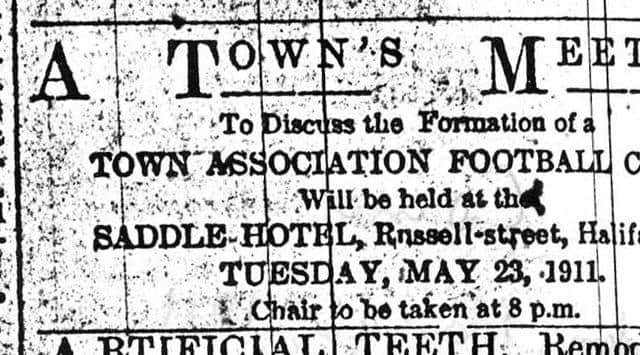
It’s no coincidence that this article appears this week on the Halifax Courier website, for Thursday, May 23 saw the 113th anniversary of the first public meeting of those interested in forming a professional club in Halifax.
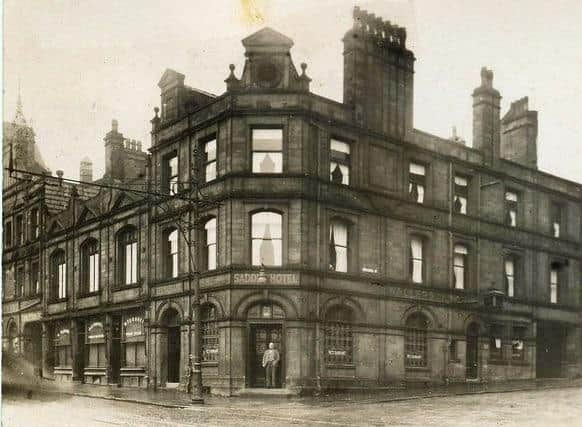

It was held at the Saddle Hotel, Russell Street, and chaired by Edmund Braginton, a wholesale grocer, who subsequently became a director of the club, with prominent personalities from the local football fraternity also in attendance.
Following enthusiastic speeches, three schemes were discussed, with a certain Ernest Jones proposing: “That this meeting of townsmen of Halifax heartily approves the establishment of a town’s association football club on the basis of Scheme 1 [the formation of a limited company] and pledges itself to adopt every legitimate means to that end”.
Charles Deantry seconded and the resolution was carried unanimously and when Braginton asked for a show of hands of those willing to become guarantors of £1, forty-six came forward, among them Ernest Jones.
A second public meeting was held at the Lecture Theatre of the Halifax Literary and Philosophical Society (now known as Harrison House) on 8 June 1911, by which time Dr Howie Muir had been elected the club’s first chairman and Joe McClelland its first secretary-manager.
"We want you to feel that this is your baby, and you must all feel you have got a strong personal interest in this club,” said Muir. “We feel that you must leave to your directors the formation of the club and what food is going to be supplied to your baby.
"We think in a while this baby will grow healthy and strong and enter a vigorous manhood, that in time will occupy a position like that of our neighbours, Bradford City.”
On 17 June, less than a month after Halifax Town’s first public meeting, the club was elected to the Yorkshire Combination.
At this point, Ernest Jones must have felt a great deal of pride, in not only seeing the formation of Halifax Town but also the speed in which it was achieved.
After all, it was his letter to the Halifax Courier, published on 20 April 1911, which had sparked the chain of events.
Using the nom-de-plume ‘Old Sport’, Jones had been alerted to the number of people to leaving the town on Saturdays to watch professional football at any one of four local Football League clubs, namely Huddersfield Town, Leeds City, Bradford City and its rival Park Avenue club, and felt the time was now ripe for Halifax to form its own.
Much is therefore owed to Edward Jones and what he instigated, but what of the man himself? Sadly, his life, though quite active, was troubled and his death certainly tragic.
Immortalised by Simon Conway in his song ‘When Glory Shone Around’, ‘Old Sport’ Ernest Albert Jones was born in Birmingham in 1870 to Joseph and Harriet Jones, living in the district of Aston, and moved to Halifax as a young man, holding a variety of jobs, including that of a painter, an employee of Halifax Corporation Tramways, and a clerk for Britannia Assurance.
Originally residing as a ‘visitor’ at Perseverence Street, he married Emma Collinge at St Augustine’s, Halifax on 28 February 1903, with the couple living at 9 Rose Street, Hopwood Lane.
They had one daughter, Gwendoline Hannah, born 26 April 1905, though tragically, she died on 28 February 1912 in Halifax Royal Infirmary aged just six.
A keen footballer from an early age, Jones, as well as being one of original guarantors of Halifax Town, was a member of the Calder Valley Poets’ Society and one of the founders of the Dickens Fellowship in Halifax.
He was a member of the Halifax Shakespeare Company and took an interest in Wainhouse Tower, being one of the collectors of subscriptions when it was advocated that the folly be purchased by the Halifax Corporation.
Jones had for many years attended the Christian Science Church, Akeds Road, but in later years was clearly troubled, possibly never having got over the death of his young daughter.
Aged sixty-six, he was found dead at his home at 5 Field House Cottages, Haugh Shaw Road, on 17 June 1935, near a gas ring from which gas was escaping.
He had left a note. An inquest delivered a verdict of ‘death from carbon monoxide poisoning, self-administered while of unsound mind’.
His wife Emma died at the home of her brother on 8 May 1945.