
I visited Wainhouse Tower, one of Calderdale’s most iconic landmarks – this is what I thought
Despite its inextricable connection to Calderdale’s history and landscape, the public have only had limited access to Wainhouse Tower until recently, when there has been an increase in the days it is open, and some 3,000 people have climbed its steps this year already. As this historic landmark gains popularity, I decided to make the ascent – along with Visit Calderdale’s Heritage and Tourism Co-ordinator Steve Crabtree – to see if the wind, cold and 369 steps were worth the visit.
Wainhouse Tower is an iconic part of Calderdale’s landscape and the tallest folly in the world. Originally intended as a chimney, the 253ft structure ultimately became an example of Victorian ostentation with its ornate balconies and grand design.
Calderdale Council have ownership of the tower, and it has previously only been open on limited days throughout the year, as Steve explained: "It’s all volunteer-led. The volunteers do a great job of taking you up there, interpreting the local landscape and the local history.”
As you would expect, the climb up to the top is long, winding and narrow, with stone steps cascading around a central pillar of brick. Steve explained the structure is pretty solid and does not require a lot of work, however the council has carried out some maintenance over the years including some repointing work and swapping iron staples holding the balcony on with stainless steel replacements.

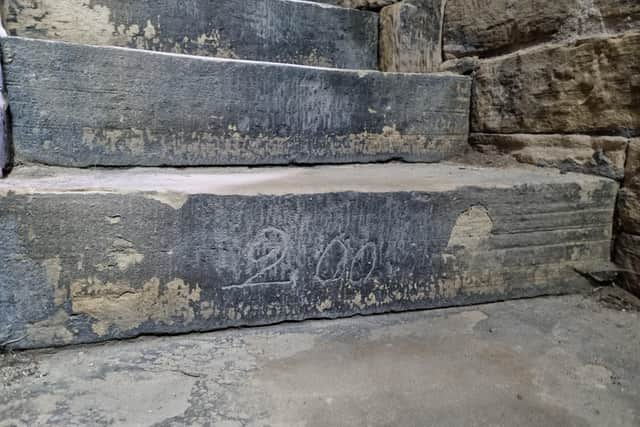
As we surpassed the halfway point of the climb, Steve pointed out a step with the number 200 etched into it – the only progress marker of the ascent. The anticipation of reaching the top is heightened in other ways, though, such as the strengthening of wind and cold in the stairwell, and intermittent slit-shaped windows in the tower’s side revealing glimpses of an increasingly impressive view of the surrounding landscape with each one you pass.
Being confident in climbing stairs is a must if you are planning on making the ascent, and it may also be helpful to some people to know there is no handrail to hold, however there are small passing places by the windows as you ascend.
To my surprise, the journey to the top took much less time than I had expected, and soon enough we were exiting the stairwell and stepping out onto the balcony which encircles the tower. Needless to say, it was fairly windy up there, and Steve explained the council will from time to time cancel tours if the weather conditions are poor.
The balcony open to the public is not, in fact, the topmost balcony, but sits several feet below it. Steve explained this is because, for the extra volunteers and paperwork it would require to allow the public access to the top balcony, it would not really add much to the experience – and I would have to agree with him; the view from the balcony we stood on is so impressive it is hard to see what a visitor would gain from being a few feet higher – other than it being slightly more windy.
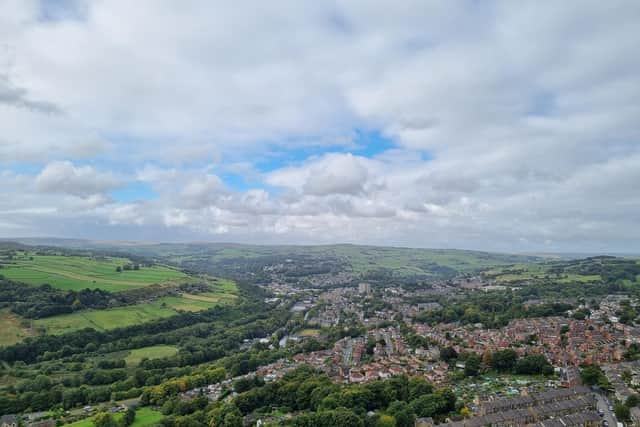
It certainly is a remarkable and unique view which showcases surrounding landmarks such as Stoodley Pike and seemingly reduces the various neighbourhoods and architectural structures of Halifax to the size of a model town. Steve said, on a clear day, it is possible to see for miles.
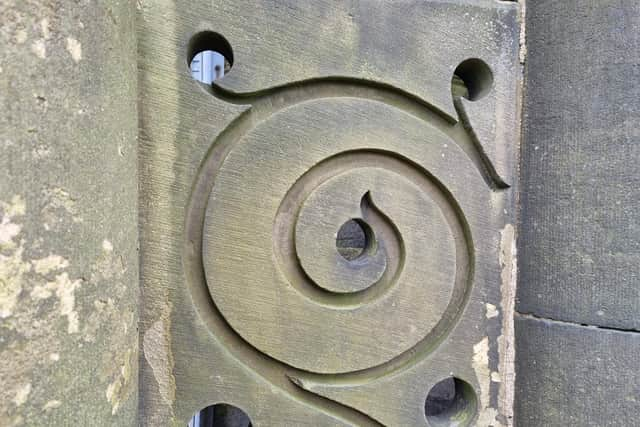
Whilst visitors will no doubt be transfixed by the view, I would recommend sparing a moment to appreciate the balcony itself; despite being invisible from ground level, the superfluous care and attention put into the stonework is telling of Wainhouse’s desire to make the tower an object of beauty. This can be seen in elaborate carvings in the stone overhead as well as the balustrades which alternate between curved and edged.
Steve said the tower itself is built directly onto the bedrock and does not have any foundations. It weighs 9,000 tons, and was originally intended to serve as a chimney for the Washer Lane Dyeworks. It took around four years to build, and was completed in 1875.
As residents are sure to be familiar with, also visible on the balcony are the lights responsible for illuminating the tower at night. Steve explained that the colours can change for special occasions, however the default colours are orange and green, which are not related to St Patrick’s Day – a common misconception, he added.
In the past, it has usually been bank holidays when visitors could book a tour up to the balcony, however this year the tower has been open more frequently and the amount of visitors has increased as a result. Of the 3,000 or so who have made the ascent this year, Steve said some 300 of them have travelled from beyond Calderdale to visit the tower, with some coming from as far as Australia and New Zealand.
Despite the potential for the tower to become more of a tourist attraction in the future, it is still a symbol of home to many local residents of Halifax and Calderdale.
Steve said: "It’s a great local landmark, you can see it from miles around. A lot of people say that you can see it from the motorway and that’s when you know that you’re home, back in Calderdale and safe and sound.”
According to Visit Calderdale, the last planned tower ascent for 2024 will take place on October 19, however starting next year there are plans to have the tower open twice a month plus on bank holidays between April and September.
More information about the history of Wainhouse Tower, as well as links to booking information, can be found on the Visit Calderdale website which can be found here.