
Former England footballer to unveil plaque at Halifax school in honour of world's first black international player
A plaque honouring the world’s first black international footballer will be unveiled by England’s first black international Viv Anderson at a Halifax school later this month.
Former Nottingham Forest, Arsenal and Manchester United defender Viv Anderson will inveil the dedication to Andrew Watson at the Crossley Heath School on Skircoat Moor, where Watson was a pupil.
There will be a special celebratory supper at the school the evening before, with presentation talks by football historians Llew Walker, author of Andrew Watson, a Straggling Life: The Story of the World's First Black International Footballer, Bill Hern, co-author of Football’s Black Pioneers, Mark Metcalf and Richard McBrearty, curator at the Scottish Football Museum. All four will also be addressing some school groups over the two days.
Andrew Watson captained Scotland to a 6-1 win over England on his debut in 1881.


Watson's mother, Anna Rose, was a black woman born into slavery who along with her mother Minkie was freed as a young girl.
His father, Peter Miller Watson, was a white Scottish solicitor highly influential in Demerara, where he looked after the affairs of Sandbach, Tinne and Co, a firm that exported sugar, coffee and rum and had been involved in the slave trade.
Unlike most illegitimate, mixed-race children in Victorian times, Watson, a cousin to Prime Minister William Gladstone, had an excellent education that acted as the springboard to a life worth living.
At aged ten, he passed his entry exams to become a pupil at Queen Elizabeth’s Free Grammar School in Heath, Halifax in August 1866.
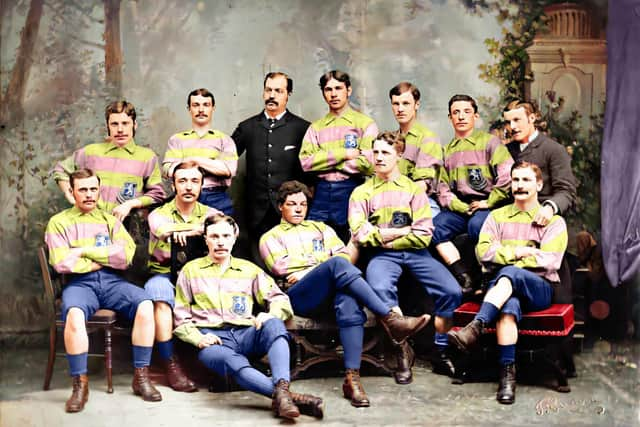
He left in 1871 to become a pupil at King’s College, London and enrolled in 1875 at the University of Glasgow, a city home to the world-famous Queen’s Park FC, credited with inventing the passing game, where Watson became a star.
He three times won the Scottish FA Cup and played three times internationally, winning on each occasion.
The second victory, 5-1 at the original Hampden Park, was a pivotal result that convinced the English Football Association to change its approach to the game, with Watson being recruited to play for the Corinthians, based in London, where he helped English players develop away from the dribbling, individual game.
He later represented Bootle FC before becoming an administrator, investor and match official within football, becoming the first black man to do so.
Watson is therefore probably the most influential black footballer of all time.
One man who comes close to challenging the Scot is Anderson, who twice won the European Cup with Nottingham Forest and who in 1978 became the first black player to represent England when he faced Czechoslovakia at Wembley.
Trailblazer Anderson went on to play for his country on 30 occasions and he has been followed by 115 black and ethnic minority footballers since.
Now, over 150 years since he lived in Halifax, Crossley Heath Grammar School, which can date its history back to 1585, has combined with local football historian Mark Metcalf to raise funds to pay for a plaque to be installed at the school gates entrance on Skircoat Moor.