
"His story needed to be told" - One of Halifax's unsung heroes is honoured at civic ceremony
Halifax has honoured one its unsung heroes in a civic ceremony at the central library.
Marine David Moffatt was one of the 'Cockleshell Heroes' involved in Operation Frankton in 1942.
He was one of eight servicemen who died taking part in the commando raid using kayaks on ships in German-occupied France during World War Two.
Attended by his nephew, also called David, and niece Helen, his only close relatives, and dignitaries from Calderdale Council, the event formally recognised Mr Moffatt's bravery and service, and dedicated a specially-written poem in his honour before a commemorative stone was unveiled.
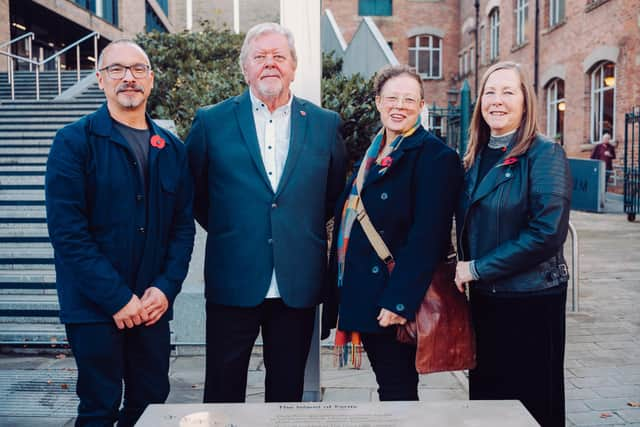

Operation Frankton damaged six vessels in the port of Bordeaux, and Winston Churchill believed the mission shortened the war by six months.
The young men paddled 75 miles through treacherous seas in two-man canoes – or ‘cockles’ – to reach their target.
David’s body washed ashore on the beach at Île de Ré days later and was buried by German soldiers in the sand dunes.
His bravery has been immortalised on plaques and at war cemeteries in both England and France, but the only dedication he had received from Calderdale was in the War Memorial Book at the Halifax Town Hall.
Helen said: "It feels amazing.
"We didn't really find out much about him until around 2000, so for people to know the story more and know about his life, it's brilliant.
"And it's lovely that it's been near Remembrance Sunday."
David said: "Around three years ago, three guys Halifax, Ian Richardson and Chris Whitworth, and Jude Garland, two ex-marines, said to us 'why is nothing known about Marine Moffatt in his hometown?'

"We'd never thought of that, and we then got an approach from a councillor who said they were thinking of doing something to commemorate him.
"We spoke to the Mayor at the time, Angie Gallagher.
"And it's snowballed from there."
Marine Moffatt was born in Belfast but lived in Halifax from the age of two, growing up in Wheatley.
He attended St Joseph's Catholic School and was a member of St Bernard’s Scouts before working at John Crossley and Sons and Balme and Pritchard.
He enlisted in the Royal Marines when he was 21.
"He volunteered for hazardous service," said David, "which was almost guaranteed to put him in harm's way, and went on this mission that was entirely secret.
"No-one knew about it until they were on the submarine in Scotland, that's when they were briefed.
"These lads put themselves in harm's way because they felt it was the right thing to do.
"David was one of thousands, so hopefully by paying tribute to him, we're paying tribute to all of them.
"It feels emotional, and like we're doing him a service for what he did.
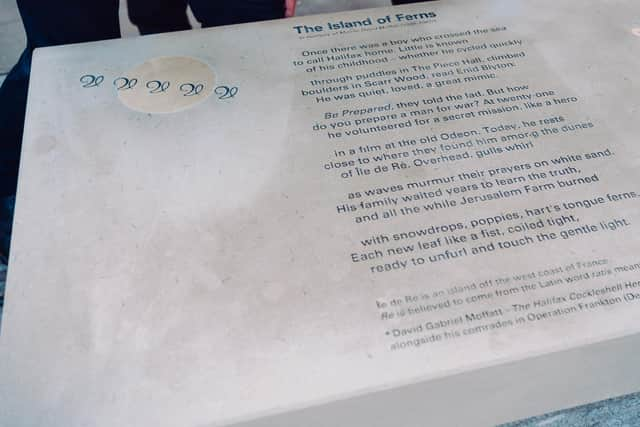
"The commemoration is made from a lovely piece of Yorkshire stone and it has the poem inscribed on it, with some visuals to highlight elements of the poem.
"And it also has information about the operation. There's also a permanent exhibition at the library about it all and Marine Moffatt, which resolves the issue of nothing being known about him."
Poet Ian Humphreys, who lives in Hebden Bridge, won a commission for the project and has been working on the poem for over a year, as well as leading workshops about war poetry.
"I met with David and Helen right at the beginning of the project, and they told me everything they knew about their uncle," he said.
"They remembered he was quite quiet, he was a great mimic, and he enjoyed being in the local countryside.
"So those things were woven into the poem.
"They also told me about the 1955 film called The Cockleshell Heroes, which is also hinted at in the poem."
Ian's poem is called The Island of Ferns.
"He's buried in Île de Ré, which the best translation we know of, is The Island of Ferns.
"And I thought that linked nicely to the fact that, as a boy, he played in the local countryside, and when I first moved here, it was the ferns that really caught my eye.
"So I thought was a nice connection with the landscape here and where he's buried."
Ian added: "It's a complete honour, a real honour.
"From what I understand, it's long overdue.
"The family were Irish, and David came over when he was a child, which is a key part of the story to me.
"It felt like it was long overdue, he needed to be remembered and his story needed to be told."