
'It’s decline has been a cause of great concern': Support for replacement of gruesome Halifax landmark
Support has been voiced for the replacement of a grisly Halifax landmark.
A replica of the town’s famous gibbet has stood off Gibbet Street since 1974 but it is rotting, and Calderdale Council intends to remedy this with a carefully-crafted replacement.
And the council’s planning application has brought the originally medieval instrument of punishment back into the public eye.
The original beheading blade was used as a capital punishment in Halifax between 1286 and the final executions in 1650.
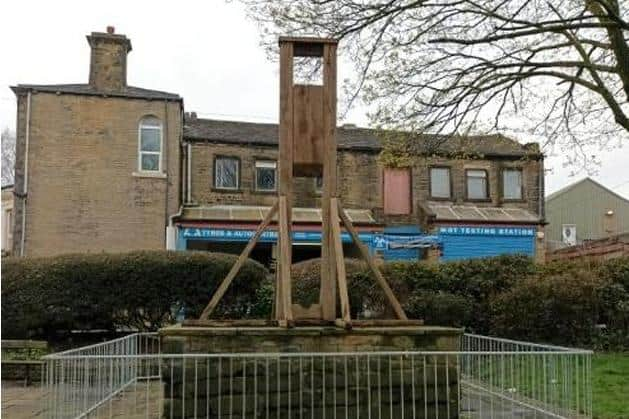

The gibbet utilised a large axe blade and upright posts.
A plaque near the replica names more than 50 people who are known to have been executed by the blade.
Restoration and replacement is supported by Halifax Civic Trust, whose chair, Alan Goodrum, says the gibbet is a heritage asset for the town.
“It’s very important it’s maintained, so we support the application to restore and replace the timber, but to do it sensitively.
“Bringing into prominence sites like this which have a lot of history attached to them and getting visitors to this part of town is very important indeed,” he said.
The Civic Trust’s vice-chair – and current President of Halifax Antiquarian Society – David Glover said this particular gibbet replica was put up in 1974 – the year Calderdale was formed.
“We’ve had great pleasure in showing people this replica for many, many years – it’s decline has been a cause of great concern because is is one of the symbols of Halifax.
“Halifax Antiquarian Society has an emblem which has the gibbet on it as it is one of the famous sites of Halifax, albeit very gruesome – not everyone likes to be reminded of the Halifax gibbet!” he said.
The replica recreates what the structure looked like – and it is possible to see one of the gibbet’s original axe blades, which provides a very realistic lesson in history, at Halifax’s Bankfield Museum.
Museum manager Richard Macfarlane says the blade is one of those historical items that is “absolutely unique”.
“There isn’t another one like it in the world.
“The Halifax gibbet pre-dates the guillotine by hundreds of years.
“This gibbet blade is part of it, it is the original blade that was there,” he said.
The council says the look or purpose of the replica will not change: “The aim is to ensure this important – and grisly – part of Halifax’s history continues to be remembered for generations to come.”
The council listed building consent application for the new structure outlines how the renovation will be carried out.
It is an old oak structure and minimal intervention using traditional methods and techniques will be deployed.
Green, unseasoned oak will be used – the same material as it is replacing – modern materials will be avoided, and mostly glue or resin will be avoided too – “we will use traditional fixing methods and will use the existing fixing holes to fix the new structure,” says the council.
Twelve months after installation, the green oak should have air dried and timber preservative can be applied, say supporting statements with the application.
The old structure will be removed top down, nuts and bolts re-used where practicable, and templates made from the existing sections at workshops.