
World's first black international footballer to be honoured by plaque at Halifax school where he was a pupil
A plaque honouring the world’s first black football international player Andrew Watson will be unveiled in Halifax next year by Viv Anderson, England’s first black international footballer.
Andrew Watson, the world’s first black football international, will have a plaque unveiled next March, with the exact date to be fixed in January, in his honour at Halifax’s Crossley Heath Grammar School, where he was a pupil.
The ceremony will be performed by Viv Anderson, England’s first black international footballer.
Watson captained Scotland to a 6-1 win over England at the Kennington Oval on his debut in 1881. Two days later he led his country to a 5-1 win against Wales at Wrexham.
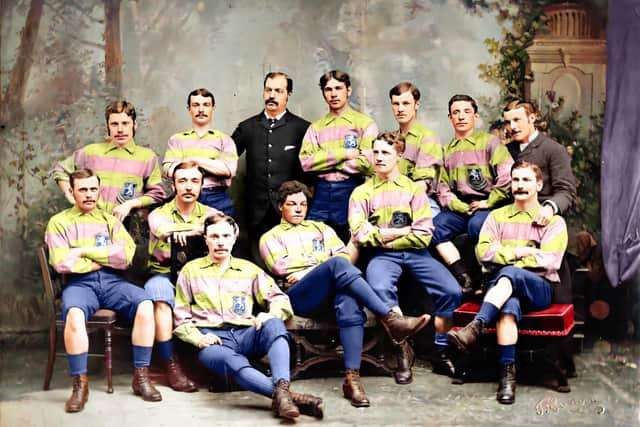

Watson's mother, Anna Rose, was a black woman born into slavery who, along with her mother Minkie, was freed as a young girl.
His father, Peter Miller Watson, was a white Scottish solicitor, highly influential in Demerara, where he looked after the affairs of Sandbach, Tinne and Co - a firm that exported sugar, coffee and rum and had been involved in the slave trade.
Unlike most illegitimate, mixed-race children in Victorian times, Watson, a cousin to Prime Minister William Gladstone, had an excellent education that acted as the springboard to a life worth living.
At aged ten, he passed his entry exams to become a pupil at Heath School, formally known as Queen Elizabeth’s Free Grammar School in Heath, Halifax in August 1866.

He left in 1871 to become a pupil at King’s College, London and enrolled in 1875 at the University of Glasgow, a city home to the world-famous Queen’s Park FC, credited with inventing the passing game, where Watson became a star.
He won the Scottish FA Cup three times and played three times internationally, winning on each occasion.
His second victory against England, 5-1 in 1882 at the original Hampden Park, was a pivotal result that convinced the English Football Association to change its approach to the game with Watson being recruited to play for the Corinthians, based in London, where he helped English players develop away from the dribbling, individual game.
He concluded his career in football by becoming the first black professional by playing for Bootle FC, having earlier become the first black football administrator, investor and match official within football, as well as the first black international footballer and captain.
Watson is thus probably the most influential black footballer of all time.
One man who comes close to matching the Scot is Viv Anderson, who twice won the European Cup with Nottingham Forest and who in 1978 became the first black player to represent England when he faced Czechoslovakia at Wembley.
Trailblazer Anderson went on to play for his country on 30 occasions and he has been followed by 110 black and ethnic minority players since.
Now, over 150 years since he lived in Halifax, Crossley Heath Grammar School, which can date its history back to 1585, is combining with local football historian Mark Metcalf to raise funds to pay for an Andrew Watson plaque to be installed at the school gates entrance on Skircoat Moor.
In addition to Viv Anderson, there will be a small number of speakers on the day including local councillor Colin Hutchinson, Headteacher Dean Jones, Richard McBrearty of the Scottish Football Museum and a pupil from the school.
Dean Jones, Headteacher of the Crossley Heath School, said: "Andrew Watson's career as a footballer provides inspiration for us all to realise that we can achieve our goals regardless of the status quo in society and expectations others may have for us.
"Our individual strength of character and talent allow us to break down barriers to reshape the world we inhabit for the better.
"He exemplified our school vales of kindness, courage and excellence. Seeing a student from the history of The Crossley Heath School set an example of the value of diversity to us all, further motivates our present students to positively contribute to society themselves and help make our world a better place."
Richard McBrearty, curator, Scottish Football Museum said: "Andrew Watson, the world's first black international footballer, can be considered to be one of the most influential footballers of his generation.
"Simply put, he was a pioneer who helped to shape the modern game. He played for three of the most consequential football sides of the 1870s and 1880s in Queen's Park FC, the Scotland men's national team and the Corinthians club.
"It is wonderful to see Andrew being recognised at Crossley Heath Grammar School. As a former pupil of the school his story will be inspirational to the students of today as well as those of the future.
"Congratulations to Mark Metcalf and to everyone involved at Crossley Heath for making this happen."
Skircoat Ward councillor Colin Hutchinson said: “Too often, remarkable people disappear from view and their contribution to the world in which we live is forgotten, together with our ability to learn from their experiences.
“Without Mark Metcalf’s commitment, who would have guessed that the first black international football player had such close links to the forerunner of Crossley’s School, in Halifax, where Andrew Watson spent five formative years of his childhood, setting him up for a university education and such an influential part in shaping the early years of our national game, more than 150 years ago. It makes you wonder how current students will make their mark, in coming years.
“Just one generation after slavery was ended in British colonies, his story also tells of the talent that was able to flourish and enrich us all, given the freedom and opportunity that would have been denied to him and wasted in a life of captivity.”
Football author and historian Mark Metcalf said: “I walk past Crossley Heath School regularly and when I found out Andrew Watson had studied there then I was resolved on having him honoured.
"I’ve have previously put up on behalf of the PFA many other plaques to football legends such as Frank Swift and Joe Mercer and Kenny Davenport and I will be delighted when the plaque is unveiled by Viv Anderson who when I was a teenager made a big impression on me when I saw him face down racists in the crowd when playing for Nottingham Forest at Newcastle United.”
The Crossley Heath School has set up a JustGiving page to raise fund for the plaque. Donations can be made at https://www.justgiving.com/page/plaqueforandrewwatson.