
Calderdale councillors urged to adopt advertising policy after Pride banner row
Calderdale councillors will be urged to adopt a policy stating what can be advertised in council space after a row over Pride banners.
Members of the council’s governance and business committee have approved an advertising policy and recommend councillors vote to adopt it when it goes before full council.
The council advertising and sponsorship policy’s aim is to “guide its approach to commercial advertising on council-owned land or assets”.
The move comes after 30 Pride banners, funded after more than £8,000 flooded into an online collection, were put up all over Calderdale by the same company used by Calderdale Council for its own campaigns.
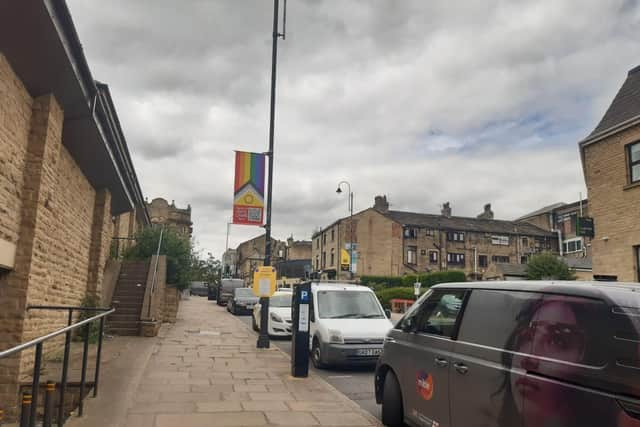

Organisers of the fundraising said they had agreed with the company for the banners to be up legally, in paid-for council-owned advertising spaces, for 12 months - so they should have been up until next summer.
But after having only been up for a few weeks, they disappeared, with Calderdale Reform then admitting they had ordered the banners’ removal.
Organisers of the fundraising – which started after Reform councillors said the Pride flag would not be flown over any council buildings during Pride Month – are seeking legal advice.
A report before Monday’s committee meeting said setting out a policy will establish “clear principles regarding the types of advertising and sponsorship which would be acceptable and those that would not”.
"It also ensures the council would only accept advertising and sponsorship from organisations whose activities, products and services are lawful and align with the council's corporate priorities and values,” the report added.
The policy sets out a list of advertising and sponsorship which would be banned from council spaces.
These include promotion of a political party, candidate or lobbying groups; food and drink that are high in fat, salt and/or sugar; alcohol; and any unproven health and weight loss products.
The policy says the list of prohibited products, services and organisations is not exhaustive and the council retains the right to decline any advertising with any organisation which the council considers “inappropriate or incompatible with its objectives”.
At the meeting, Coun Dan Wood (Green, Northowram and Shelf) referred to some of the restrictions, including on some aspects of business advertising where some which might be banned might not if they were locally-based – it seemed entirely discretionary.
The councillors heard if there is any doubt, the council’s communications team should refer the matter to the relevant member of the corporate leadership team for decision in agreement with the cabinet portfolio holder.
Coun Ashley Evans (Lib Dem, Warley) wanted to see consistency and transparency in that process – that if advertising was turned down at the highest levels, reasons were openly given about why it was turned down.
Back on financial aspects, answering Coun Val Mycroft (Reform UK, Hipperholme and Lightcliffe), officers said the council would decide the proportion of commercial to public service information and events advertising.
Coun Wood’s bid via an amendment to include businesses related to fossil fuels on the banned list was defeated.