
'What was underground wasn’t necessarily what was expected': Council explains why Halifax roadworks progress has been hindered
Unseen obstacles have stymied the pace of major roadworks around Halifax town centre.
But project targets are still deliverable despite some unexpected problems to untangle, says a senior councillor.
As reported by the Courier, some Halifax business owners have raised concerns about about the impact months of roadworks are having on their trade.
They say the highway disruptions are putting people off coming into the town centre.
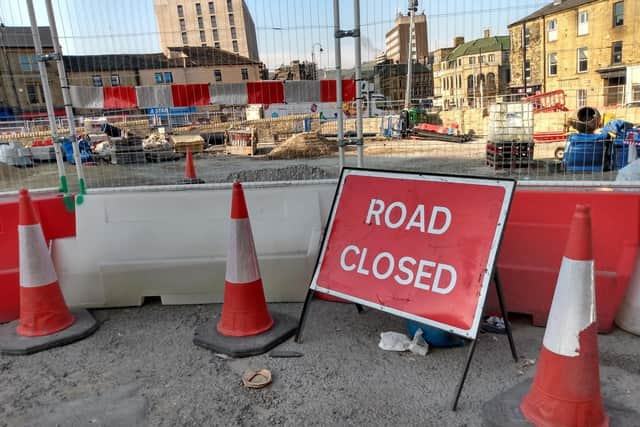

Ongoing phases to upgrade the major A629 route and remodel parts of the town centre will bring benefit in the long run, say senior councillors, but some businesses say the disruption might be too high a price to pay.
Their concerns were taken up by Coun Regan Dickenson (Con, Rastrick), who sought assurances about how ongoing works would be handled.
In a questions-to-cabinet session, he said town centre businesses were reporting a “significant” drop in footfall.
“Local Halifax businesses have said the disruptions caused by phase two of the A629 Halifax town centre western corridor project are severely impacting their livelihoods,” he said.

“The western corridor is due for completion in late 2025.
“Whilst the Conservative group supports this vital investment to revitalise Halifax, please provide reassurance that the western corridor project remains on track to finish by that date, and confirm that work on subsequent phases will not begin until the current phase is fully completed, as initially promised, because overlapping construction works would only exacerbate the challenges faced by local businesses and residents.”
Responding, cabinet member for Regeneration and Transport, Coun Sarah Courtney (Lab, Calder) said the works were presenting a number of logistical constraints and technical complexities, including navigating uncharted statutory and undertaker assets – in essence, utilities which run under the ground.
She said these included: “Localised historical anomalies such as concrete slabs protecting the shallow services, historic setts, buried structures, unexpected voids and legacy drainage systems.

“So, basically, what was underground wasn’t necessarily what was expected.
“Despite these challenges, the current programme remains deliverable with careful planning, continuous risk review and ongoing co-ordination with relevant third parties.
“Work is planned carefully to minimise disruption as much as possible.”
Coun Courtney said contractors were in regular contact with businesses and surrounding properties to provide updates and listen to concerns, and during more disruptive activities – such as road surfacing – staff were there to help motorists negotiate their routes.
On phasing of the whole scheme, there had been exploratory and investigative works undertaken outside of the western corridor to de-risk future works – generally these were carried out overnight and would not detract from focus on delivering the western corridor efficient, said Coun Courtney.
The project team were working with contractors and specialist consultants to identify efficiencies, including bringing forward some “offline” works from subsequent phases, she added.
An example would be Old Church Street between the Hughes Corporation building and the Eureka! museum car park wall.
While there were some issues at the moment, it was a lot of investment in the town and would bring future benefits, she said.