
Soccer Siftings: When a former England international was enticed to join Halifax Town
In the latest installment of his Soccer Siftings series for the Courier, Halifax Town historian Johnny Meynell looks back at when a former England international was enticed to join The Shaymen.
It’s a phrase you hear more and more of these days, of footballers ‘chasing the money’, turning down the offer of a new contract with their present club for a more lucrative one elsewhere.

Where FC Halifax Town are concerned, we’ve recently seen the likes of Jeff King and Mani Dieseruvwe sign for clubs who have seemingly offered better deals, and much the same could be said of Jack Hunter, now at Hartlepool.
Dountless Tylor Golden and Jamie Stott will be financially better off, too, wherever they rock up.
Football has changed and lost all semblance of what it used to be. Gone are the days when a player such as Paul Madeley, an established England international, would sign a blank contract with Leeds United because he didn’t care too much about what was being offered, he just wanted to play for the club he clearly loved.
By that time, the early seventies, footballers were no longer restricted by the maximium wage, but up until 1961, following a campaign led by Jimmy Hill, footballers certainly were, with Fulham’s Johnny Haynes famously became the first £100 a week player once restrictions had been lifted.
One wonders how negotiations were concluded when Halifax Town were enticing a former England international to their then Sandhall Lane-based club. Having been formed in 1911, the club, whose nickname was interchangeably ‘Magpies’ (because of their black and white striped shirts) or ‘Sandhallites’ – or ‘Town’ for short – had initially played in the Yorkshire Combination, but sought better players for 1912-13 when they switched to the stronger Midland League.
An abundance of players travelled down from Scotland, though whether they could have been seen as ‘chasing the money’, it’s unclear.
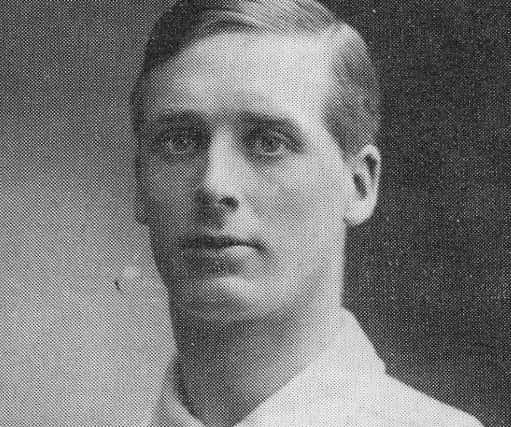
One wonders, however, just what sort of financial deal was offered a to a certain Fred Pentland, who, in opted to join Halifax Town from Middlesbrough, a club who were members of the Football League’s First Division.
In days of yesteryear, whilst players did move from clubs, it wasn’t uncommon for many to pledge their allegiance to a local club and remain there until the clubs themselves decided they no longer needed them.
This was the era of the much-maligned retain and transfer system, when clubs had all the power and footballers were often viewed as serfs.
The fact was, in Pentland’s case, despite being a regular for Middlesbrough in 1910-11, he’d featured just once the following term due to a ‘disciplinary’, so it is safe to assume that the Ayresome Park club no longer valued him.
Of his playing career, Halifax Town became the latest – and last – stop-off point in a career which had seen Pentland, to coin a phrase, have ‘more clubs than Jack Nicklaus’.
He was, to all intents and purposes, one of the game’s first mavericks, an entertainer who enjoyed a nomadic and colourful career but a personality whose eccentricity belied his astute knowledge of the game. Yet only three years before his arrival at Sandhall, he had been an England international, winning the last of his five caps in June 1909.
Born in Wolverhampton on 18 September 1883, Pentland combined his time as a gun maker’s assistant by playing for junior clubs Willenhall Swifts and Avondale Juniors.
His first professional club was Small Heath (later to become Birmingham City) whom he joined in August 1900, but in three seasons with them he played only one senior match, appearing at inside-left in the side’s 2-1 defeat at Portsmouth on 14 December 1901.
It was with Blackpool, whom he joined in June 1903, that Pentland came to the fore.
He made eight league appearances for the club, scoring his first goal in the 4-1 defeat of Stockport County on 26 September 1903, and enjoying a five-goal scoring spree in four consecutive matches which he earned himself a quick-fire move to First Division Blackburn Rovers.
Pentland responded by netting seven goals from eighteen league appearances in his first season, grabbing his first goals by scoring a hat-trick in the 4-0 defeat of Newcastle United on 5 December 1903, and helping Rovers avoid relegation.
But he struggled to find the goals thereafter and in May 1906 he joined Southern League outfit Brentford along with team mate Tom McAllister.
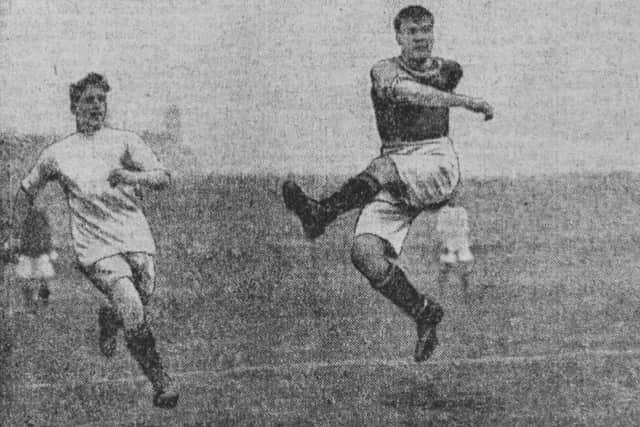
Pentland was a great success at Griffin Park, once netting four goals in 4-2 victory over Reading, and in his one season with the club missed just two matches, scoring twelve goals from 36 matches.
But it was at fellow Southern League side Queen’s Park Rangers that Pentland found his best form, operating on the right wing.
He missed just one match of the 38-match programme and scored fourteen goals, being instrumental in helping the side clinch the 1907-08 championship.
Rangers were invited to contest the inaugural FA Charity Shield with FA Cup winners Manchester United, and Pentland featured in the match, which was drawn 1-1 at Stamford Bridge on 27 April 1908 and necessitated a replay.
But by the time the contest was replayed at the start of the following season, Pentland had joined First Division Middlesbrough, and though he wished to play in the match and, indeed, special dispensation was put in place for his inclusion, Pentland wasn’t selected and United won 4-0 without him.
Pentland would spend four seasons with Middlesbrough, supplying the ammunition for Alf Common, Steve Bloomer and a young George Elliott.
And it was during his time at Ayresome Park that he gained international recognition, winning his first England cap in a 2-0 win over Wales in Nottingham on 15 March 1909, though disappointingly for him, he was injured in the fifteenth minute of the match and rendered a passenger.
But he recovered sufficiently to help England defeat Scotland at Crystal Palace three weeks later, then was part of the England party which undertook a continental tour in June 1909, with Pentland a member of the side which defeated Hungary twice (4-2 and 8-2), then beating Austria 8-1 in Vienna in what was his last appearance for his country.
Pentland served Middlesbrough well, and following the sales of Common and Bloomer in 1910, was deployed at centre-forward throughout the 1910-11 season.
In February 1911, however, he was suspended by the club for fourteen days after ‘neglecting his training’ on the eve of an FA Cup tie, but returned to the side to score after only two minutes in a 2-0 win over Preston North End. Pentland went on to make 92 league appearances and score eleven goals for Boro but he spent the 1911-12 season with the reserves, averaging over a goal a game to help the side claim the North East League Championship.
For all of this, Pentland’s signing for Halifax Town was indeed a major coup by Joe McClelland and the directors.
He scored on his debut in the season’s opening home defeat by Doncaster Rovers and went on to find the net regularly, forming an effective combination with Tommy Simons.
He played a crucial part in Halifax Town’s FA Cup exploits which culminated in a return to his former club Queen’s Park Rangers in the first round.
He chipped in – literally – with a goal to give Town a shock 2-0 lead, but the fairytale return to Park Royal ended in a 4-2 defeat.
Despite their achievements, the run in the FA Cup hadn’t made Halifax Town a rich club, and Pentland was one of several players sold in February 1913.
He joined Southern League Stoke City for a substantial fee but was unable to prevent the Potters’ relegation from the Southern League First Division.
He contributed one goal from five appearances towards the end of that term but had netted five goals from just seven appearances the following season when he elected to rejoin Halifax Town in December 1913, his name mentioned in the position of player-manager, though with Joe McClelland still overseeing team affairs, Pentland’s role was more of that as a coach.
He reappeared in the Town team for the match with Sheffield United Reserves on 20 December 1913, scoring his side’s goal in the 1-1 draw and featured regularly until he suffered a strained knee when playing in Town’s Good Friday match at Goole Town, 10 April 1914, an injury which kept him sidelined for Town’s next two fixtures, the last of which was a drawn Bradford Hospitals Charity Cup tie with Heckmondwike on 14 April.
Pentland announced himself fit for the replay two days later, but broke down after just ten minutes and hobbled along as a passenger (no substitutes in those days) possibly doing untold damage to his knee.
And whilst the Magpies won the match to reach the final, Pentland was forced to watch from the sidelines as Town defeated Scarborough 5-0 to lift the club’s first piece of silverware.
By then, Pentland was planning the next stage of his career, and upon the season’s close, he secured an important position under the German Olympic Council, based in Karlsruhe, Baden, coaching German athletes for the scheduled 1916 Games in Berlin.
But the outbreak of war meant he, along with other well-known footballers such as his former colleague Steve Bloomer and Sam Wolstenholme, was interned for the duration of the war, any concern for him back home being allayed by a statement sent on his behalf by the Netherlands Football Association which indicated that Pentland ‘is treated well enough in every respect.
He asks me to let his people know that he is not in want of anything but money. He can go about as he likes, but he cannot leave Germany’.
When peace was restored, Pentland returned to England, but by the time of the 1920 Amsterdam Olympics he was coaching France.
He then began his long association with Spain, coaching several clubs, including Racing de Santander and Athletic Bilbao, whom he led to unprecedented success in three spells.
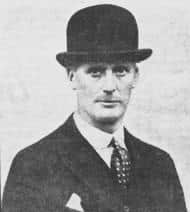
Here, Pentland’s first act at Athletic was to show the players how to tie their bootlaces correctly: ‘Get the simple things right and the rest will follow’, was apparently his motto. Pentland smoked big cigars and wore his bowler, even in training, which his players would ritually whip off his head and stamp on until it was no more.
Despite his apparent eccentricity, Pentland revolutionised Bilbao’s style of play, introducing the short-passing game, which he in turn brought to the national side when he was appointed coach under manager Jose Maria Mateos.
It was said that Pentland was the real mastermind of Spain’s 4-3 victory over England in May 1929 when they became the first Continental side to defeat England.
After a third spell at Athletic Madrid, Pentland returned to England at the outbreak of the Spanish Civil War, acting as assistant manager and coach under Harry Curtis at Brentford, before becoming manager of the footballing outpost at Barrow in January 1938.
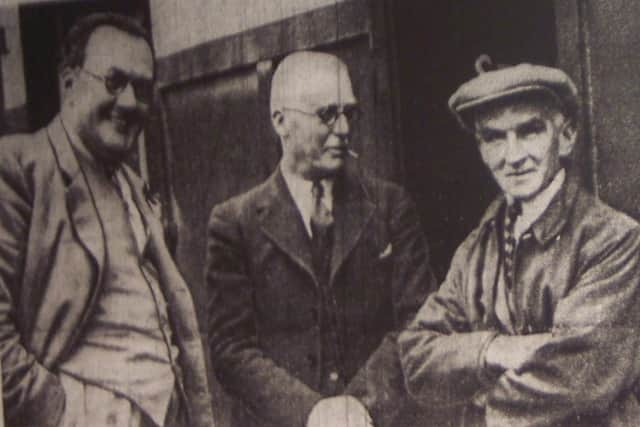
He returned to Halifax with his new club the following April – Pentland, of course, never played for Halifax Town at The Shay – and sat in the directors’ box along with former director Ted Braginton whilst seeing his side claim a point in a 1-1 draw.
The following season, Pentland saw his side lose 1-0 at The Shay, the only goal scored by debutant Fred Mason, who thus matched the feat of Pentland, who had netted on his first appearance in 1912.
On a happier note, the former Town player did get the chance to meet up with Judd Wild, one of his former colleagues from those far-flung Sandhall days.
Pentland remained at the Holker Park club until June 1940 when, with the nation once more at war, he was released as part of an economy drive. Pentland and his wife Nahneen, whom he had met when he was recuperating following release from Germany in 1919 and who he married in 1923, moved to Stourbridge, then to Richmond, Surrey.
Following the death of his wife in 1951, Pentland moved to the village of Lytchett Matravers, outside Poole in Dorset, where he died in March 1962 aged 78.