
Forgotten story of Halifax schoolboy who saved a life before dying in WWI uncovered in new research
The forgotten story of a Halifax schoolboy who saved a life before dying in WWI has been uncovered in new research.
The story was uncovered by historian, broadcaster and author David Olusoga using a new digital tool brought by the genealogy subscription service Findmypast.
The tool uses large-scale machine learning to connect the UK’s war memorial data with millions of historical records and newspaper archives, and helped to bring the story of Halifax schoolboy Arthur Edward Roberts to life.
Arthur Edward Roberts was born in 1899 and grew up on Pear Street before moving with his family to St Bevan’s Road in Skircoat Green.
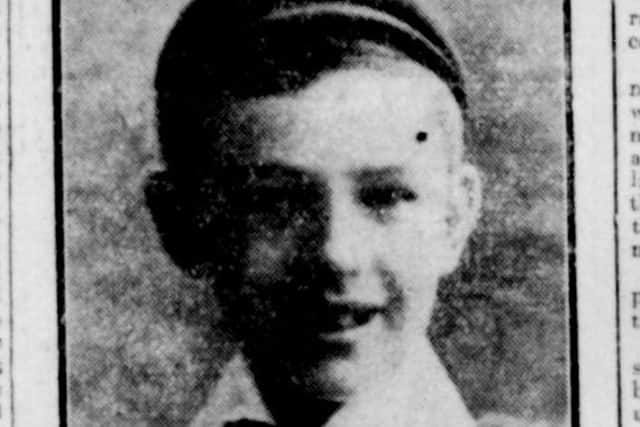

He is one of 776 names commemorated on the Halifax Books of Remembrance Memorial.
His father worked in the wine trade and by 1911 had become a wine merchant’s manager.
In June 1912, aged 12, Arthur came to public attention when he rescued a friend from the canal at Copley.
Arthur tied a rope around his waist, tied it to a pole and entered the water in order to rescue his friend.
The rescue was reported in local newspapers, and the Mayor of Halifax presented Aruthur with a testimonial from the Royal Humane Society.
His teachers and fellow school pupils at Trinity School presented him with an oak frame to display the certificate, as recognition of his achievement.
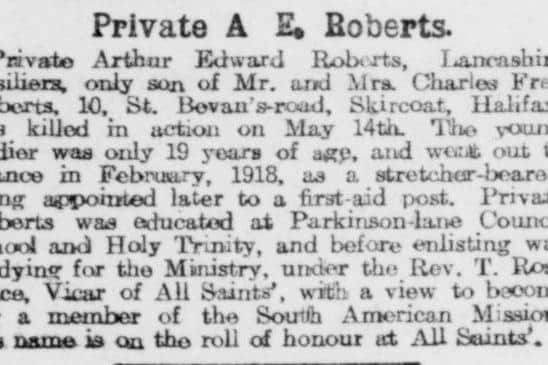
During WWI, Arthur enlisted in Halifax and served as a private with the 2/5th Battalion, Lancashire Fusiliers.
He arrived in France in February in 1918 and served as a stretcher-bearer before being appointed to a first-aid post.
On May 14, 1918, he was sadly killed in action aged 19.
He is buried at Houchin British Cemetery in France.
Speaking about Arthur’s story, David Olusoga encouraged people to discover the stories behind the names on local war memorials this Remembrance Day.
David Olusoga said: “What struck me about Arthur was not only the tragedy of his death, but the richness of the life he lived before the war.
“By uncovering stories like his, we can begin to see these memorials not simply as monuments to conflict, but as memorials to individuals whose lives helped shape the communities we know today.
“War memorials are among the most familiar historical landmarks in Britain, but for many of us the names engraved on them have become distant and anonymous. Yet every inscription represents a life that extended far beyond military service and a loss that was felt by families, neighbours, workplaces, and entire communities.
“This Remembrance, I’d encourage everyone to visit your local memorial, select one name, and go online to discover their story.”
Jen Baldwin, Research Specialist at Findmypast said: “War memorials were never intended to be lists of names alone.
“They were created to ensure people and stories would not be forgotten. Our research shows that many people are searching for that connection and want to know more about the lives of those that came before them in their local area.
“By using technology to bring together the UK’s memorial data, historical records and newspaper archives on Findmypast, we’re helping people uncover the human stories within their communities and making remembrance more personal, meaningful and accessible for future Generations.”