
Dr's Casebook column with Dr Keith Souter: Down rabbit holes in Ripon in search of Alice and the Cheshire Cat
I was in Ripon last week and found myself going down several rabbit holes. Not literally, of course, but I found myself exploring the Lewis Carroll connection. Fascinatingly, it is possible that the author of at least two of the most famous children’s novels of all time himself suffered from a condition that has become known as Alice in Wonderland Syndrome.
The entrance to my first rabbit hole was a plaque on The Old Hall, close to the Cathedral, which explained that the Reverend Charles Dodgson (Lewis Carroll) spent three months every year between 1852 and 1858 there. His father was Archdeacon Dodgson, a canon at the Cathedral.

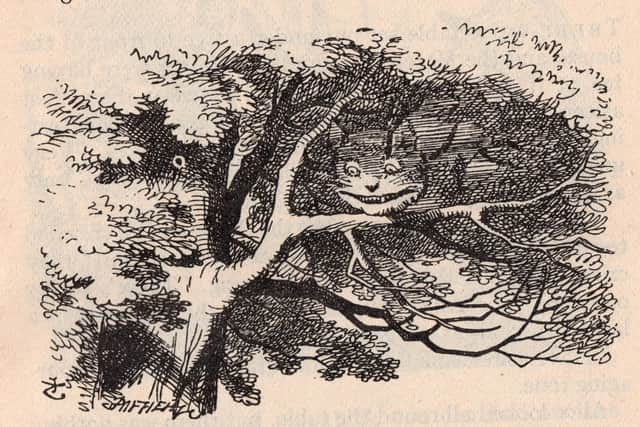
My next was the Cathedral itself where there seem to be several architectural features that inspired him and eventually found themselves into his famous book Alice’s Adventures in Wonderland. One of the most interesting is the Gryphon misericord on the Mayor’s stall, which features a gryphon chasing a rabbit as it is about to leap into a burrow. If you are familiar with the book you’ll remember reading about the Cockney accented, persistently coughing Gryphon who is charged with bringing Alice before the Queen of Hearts. Other features in the Cathedral may have inspired the Jabberwocky, the Queen herself and underneath her the Cheshire Cat.
My next rabbit hole was in the Spa gardens and the superb tree sculptures featuring a number of the characters from the books, including the Mad Hatter, the March Hare, the Dormouse, the Cheshire Cat, the Caterpillar, and of course, Alice herself.
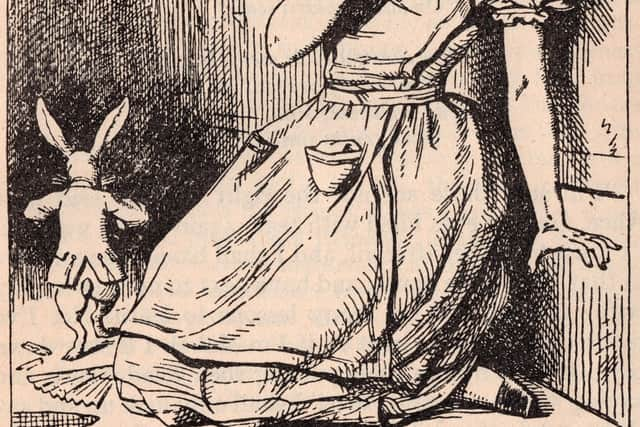
Alice’s Adventures are all quite surreal. A notable part of the plot involves Alice eating or drinking things which immediately cause her to shrink, or grow, or become elongated. This caused me to go down another rabbit hole because this imagery is typical of a condition that was named Alice in Wonderland Syndrome.
In 1955, Dr John Todd an eminent psychiatrist at Menston Hospital in Leeds published a paper describing what he termed Alice in Wonderland Syndrome. It is a group of interrelated symptoms of distorted perception. For examples, perceiving that one’s body is misshapen, with small or large hands, feeling that one is too large for a space, or that one is much smaller than reality, seeing things to be slanted and distorted, or larger or smaller than they are. Also feeling unreal, and also distortion of weight so that one feels to be sinking or even floating. All of these are perceptual distortions rather than hallucinations.
The question poses itself, how did the author come up with this gaggle of symptoms unless he had experience of them himself. Charles Dodgson’s medical history is documented, and it seems that he regularly suffered from migraine. Many of these symptoms can be experienced during the aura phase of migraine in some sufferers.
It is also possible that they may have come about if he experienced a type of epilepsy called temporal lobe epilepsy, that causes ‘absences’ and distortion of perception. But there we must leave it, for although he left diaries there is not enough information to make a diagnosis, other than a speculative one. There is no actual way we can go through the looking glass for the answer, but it was fun to contemplate.