
History Society column by Sheila Graham: The Staffordshire Hoard
Stephen Dean is senior archaeologist with the Environment Agency, but the story he brought to Hebden Bridge Local History Society began back in 2009, when he was county archaeologist in Staffordshire. A metal detectorist unearthed the largest hoard of medieval gold and silver found in northwest Europe: the Staffordshire Hoard.
The finds were in a field close to the A5 – Watling Street, a Roman road that is still a major thoroughfare. Also known as the King’s Highway, in the 6th and 7th centuries it lay at the heart of the Kingdom of Mercia when the rival kingdoms were fighting for power and land. We call this period of British history the ‘dark ages’ though the darkness only represents our view back through time. The gold that glittered in the Staffordshire field speaks of a complex and sophisticated society.
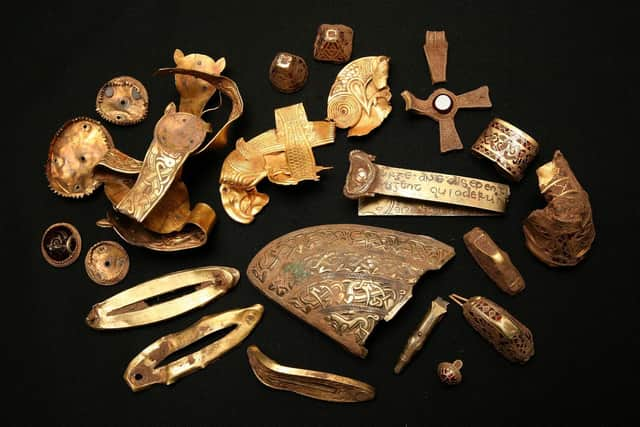

There followed a major project to secure the site and excavate and conserve the finds. Archaeologists and historians found a rich resource to explore and have learnt more about the values and customs of the times.
The key objects were overwhelmingly martial in nature, with sword pommels, pieces of helmets and other exquisitely decorated sword furniture – though intriguingly no sword blades. Sword blades were very highly valued; as well as being the most technically advanced weapon they had high social status that might merit extra protection.
There were nearly 4000 artefacts made of gold, silver, horn, ivory and textiles. The items told a story of the people who made and used them, especially as the surfaces were enriched and decorated by expert goldsmiths, technicians and artists. Decoration included cloisonne work with gold and garnets typical of Europe as well as intricate filigree in a Celtic style. There were hints of complex trading too – the garnets had Chinese and Czech origins.
The decorations often told stories, featuring battle scenes and animal imagery with symbolic as well as a literal meanings. The piercing of a horse in battle mirrored a Roman fighting technique; the horse and rider signified a passing from life to death to undermine an opponent in battle. Dragons, wild boars, eagles and lions may also have had a shamanistic power representing heroic qualities. The wearers of these items would have great dramatic presence, the decorations catching the light and declaring their place in society.
Documentary evidence for these theories comes from the Viking Beowulf saga, with pagan origins though transcribed by Christian monks. The story is a guide for kingly behaviour, modelling how to ensure loyalty by offering protection and giving gifts in return for service. Mercian king, Penda, who reigned for thirty years, gained his success in battle from a band of elite warriors with personal loyalty in just such a manner.
Was the Staffordshire Hoard a collection of such high status gifts held to reward loyal service? Such burials of treasure in times of stress are known as ‘Angst Hoards’ – before risking everything in battle you find a remote place, and bury your treasured belongings until the danger has passed.
And if you die in battle, the treasure remains unclaimed.