
'For four days, we disappeared from the world': Holiday turns to nightmare for Halifax men thrown into Israeli detention centre after war broke out in Middle East
What was supposed to be a three-day trip to Jerusalem turned into a terrifying enforced stay in an Israeli detention centre at risk of being bombed for a group of Halifax men.
Stuck in a cell in a building that was shaking every hour from the impact of missiles and drone attacks, Hassan Riaz and his friends did not know when they would see their loved ones again.
"For four days, we disappeared from the world,” said the young father, pharmacist and key co-ordinator of Halifax Community Fridge.
"My family feared the worst.”
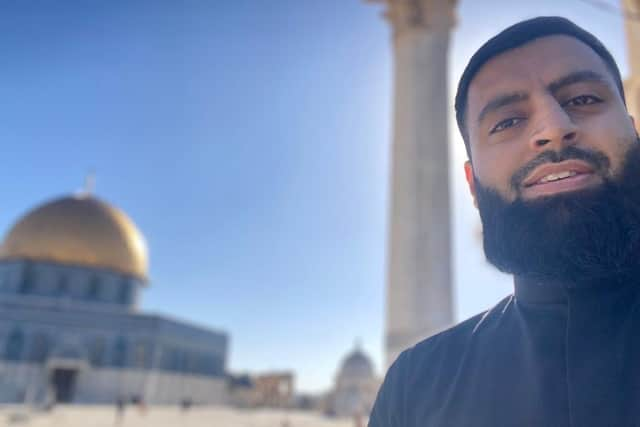

Hassan, who is also a Courier columnist, and four friends flew out to Tel Aviv in Israel on Friday, February 27 so they could visit Masjid al‑Aqsa in Jerusalem.
The mosque is considered the third holiest site in Islam. Hassan had been there in January for the first time and decided, along with his friends, to return for a special Ramadan visit.
But the group say they were stopped when they reached the airport and interrogated for five hours.
Four of the men were falsely accused of doing community work in Gaza and refused entry to the country before being booked on a return flight home to the UK the following afternoon.
But as the men waited in a dingy immigration holding room in Ben-Gurion airport, having had their phones confiscated, the first reports of war began to break.
America and Israel had launched air strikes on Iran, with Iran retaliating by firing missiles and drones at Israel and its other Middle Eastern neighbours.
"Within hours, everything changed,” said Hassan.
"We were detained and taken to Givon Prison in Ramla – the same facility that once held Greta Thunberg and the flotilla activists.
"We were told we were not prisoners but we were put in handcuffs.
"There were five of us in a single room. A small space with rusted metal bunks infested with hundreds of cockroaches.
"For four days, we disappeared from the world.
"We were refused access to a lawyer, denied contact with the embassy, and not allowed to inform our families that we were alive.
"Our meals consisted of little more than bread and yoghurt.
"When air‑raid sirens sounded – sometimes every hour – we were ordered to lie under the metal bunk beds with our hands on our heads, whilst the prison guards retreated to bunkers for their own safety.
"Piercing the quiet moments of reflection, missiles rained down from the sky, shaking the whole building; the bolted door and barred window of our prison cell rattling from the impact.
"The irony of our situation was impossible to ignore. In 2020, I launched the Halifax Community Fridge and have since helped establish community fridges across the country - spaces that provide free food and drink, 365 days a year, to people of all backgrounds.
"I have spent years working to ensure that no one feels shame in seeking support. Yet here I was, locked in a foreign prison, hungry, frightened, and suddenly dependent on the kindness of others.
"One moment in particular has stayed with me. On our second day, another prisoner – an asylum seeker - began speaking to us through the bars.
"He was assigned cleaning duties, which meant he moved through the corridor outside our cell. He had nothing. No certainty about his future. No protection. And yet, from the little he had, he gave.
"Quietly and discreetly, he slipped us extra food: an orange here, an apple there, an extra slice of bread when no one was looking.
"He risked punishment to make sure we had something more than the bare minimum we were being given.
"In that moment, the roles were reversed in a way I could never have imagined.
"I have spent years helping others access food with dignity - but now it was an imprisoned asylum seeker, himself living on the margins of a system that barely acknowledged his humanity, who stepped forward to care for us.
"Those extra oranges, those apples, those small pieces of bread - they were more than food. They were reminders that compassion can survive even in the harshest places. That dignity can be upheld by those who have been denied it.
"That sometimes, the people we expect to have the least to give are the ones who give the most.”
Hassan and his friends were told by guards they would not be able to leave until the airspace reopened – and that could be weeks or months.
But after four days, they were taken to the Egyptian border, crossed into Egypt and were among the first British people to arrive home from the Middle East since the war broke out.
When he disappeared, Hassan’s family had contacted Halifax MP Kate Dearden, who was able to track him and his friends down and reassure their loved ones that work was underway to get the men home.
Hassan says they are thankful but the experience has forced them all to confront the reality of thousands of people all around the world who remain unjustly imprisoned, without anyone fighting for their release.
“We pray for them - for their safety, for their dignity, and for the day they too can walk free,” said Hassan.
Ms Dearden said: “I'm really pleased to have been able to help Hassan and his friends and that they have now been returned back to the UK.
"I know it was an incredibly concerning ordeal for all those involved, including the family members who were unable to get in touch with their loved ones.
"At every stage, my team and I were focused on securing their safe arrival back to the UK, and ensuring that their families were kept updated and I was very moved last week to be able to meet Hassan and his family in person.
"I would encourage anyone who needs consular support to get in touch with my office immediately, and I will do all I can to support them."